How a Niche Interest Becomes a Mainstream Reference
Trace how a niche interest becomes a mainstream reference by comparing its original setting with the routes, edits and new uses that carry it wider.
A tabletop role-playing term can move from a players’ forum into a television interview, then turn up as a joke in a meeting. Tracing how a niche interest becomes a mainstream reference means following that journey: who carries it, what changes along the way and what people use it to do.
Track the route
Begin with a specific item: a phrase, practice, character type or format. Then note where it appears and how it reaches its next audience. This keeps the question on circulation rather than on whether the interest has become popular in some broad, hard-to-pin-down sense.
Three routes are especially useful:
- Community exchange: Look at fan forums, local clubs, specialist shops or hobby groups. If members explain and refine the reference for newcomers, follow how that teaching shapes its meaning; if discussion stays among experienced participants, look for another route that carries it outward.
- Media packaging: Examine television segments, podcasts, newsletters, games or short videos. If a compact part is presented without its surrounding material, compare it with the fuller source; if the media item preserves its context, note what explanation helps the new audience follow it.
- Commercial use: Check adverts, product descriptions and promotional partnerships. If a reference is used to sell something, identify the audience and the association being borrowed; if it is not being used commercially, focus on the social or editorial purpose instead.
- Everyday speech: Listen for the reference in a classroom, family chat or workplace. If speakers use it as shorthand, record what situation it describes; if they explain the original interest, note which details they consider necessary.
- Adaptation: Compare a source item with a parody, remix, translation or fan-made version. If the adaptation changes the subject or tone, record the change and who made it; if it closely follows the source, look at which features remain recognisable.
- Gatekeeping: Notice who is treated as entitled to define the reference in each setting. If a promoter or commentator speaks over practitioners, record whose account is missing; if practitioners shape the description, note how their role is made visible.
Each route answers a different question. A clip may explain why a phrase travelled; a club discussion may show how participants distinguish its uses; an office joke may reveal what it has come to mean beyond the original activity.
Where does the reference change?
What gets cut from the source?
Compare the circulating version with the material it came from. If a clip keeps a punchline but drops the scene around it, the audience may receive the joke without the reason it mattered in the original work.
Who carries it into a new setting?
Identify the person or channel that introduces the reference: a fan, presenter, advertiser or colleague. The carrier’s purpose helps explain why one part is emphasised and another is left behind.
What does the new audience do with it?
Look at the action the reference performs: it might explain a situation, signal membership, invite a laugh or sell an idea. If its new use differs from the original, describe that change without assuming everyone understands it in the same way.
Does familiarity mean understanding?
No. Someone may recognise a phrase without knowing its source, while a practitioner may understand its history but not speak for every member of a community.
Separate evidence from inference
Keep a short record for each appearance: the exact wording or action, the setting, the intended audience if stated, the route by which it arrived and the use you can observe. Add interpretation in a separate note. This distinction makes it easier to say what the material supports and what remains a possibility.
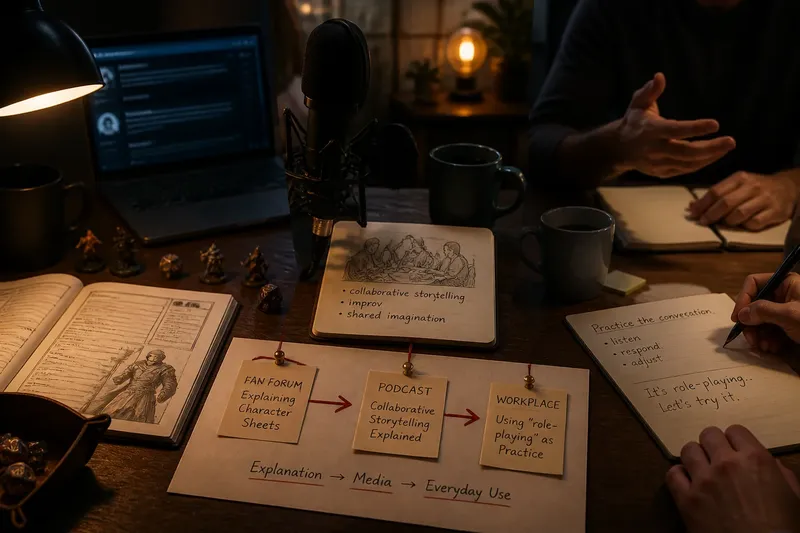
Say you are tracing “role-playing” as a reference outside gaming. Your starting material is an invented forum post where players explain a character sheet to newcomers. You then compare it with an invented podcast segment describing collaborative storytelling, and an invented meeting remark that uses “role-playing” for practising a difficult conversation. The forum offers detailed terms, the podcast makes the activity easier to picture, and the meeting remark uses the phrase as a practical analogy. Your resulting account could be that the reference travels through explanation and media before taking on a new everyday use; it could not establish that all listeners understand the activity or that this is the route every speaker followed.
Use a modest boundary for your own comparison. Choose one reference and a few settings, then record the material in the same way each time. If the route is unclear, say so rather than filling the gap with an assumed origin story.
Recognition and ownership
Wider recognition can bring attention to practitioners, but it can also make a simplified version easier to encounter than the activity itself. A promoter may benefit from an association; a community member may welcome new interest while objecting to how the subject is presented. Neither response should be treated as the sole community view.
When tracing how a niche interest becomes a mainstream reference, ask not only where it appears but what the new setting rewards. A joke, advert or casual analogy can make an interest legible to outsiders while leaving its ongoing practice out of sight. Keep that distinction in your account: circulation describes how a reference travels; it does not, by itself, tell you what every audience knows or values.