Why a Repeated Image Becomes a Cultural Reference
Learn why a repeated image becomes a cultural reference, and how recognition, repetition and shared context let people communicate more with less.
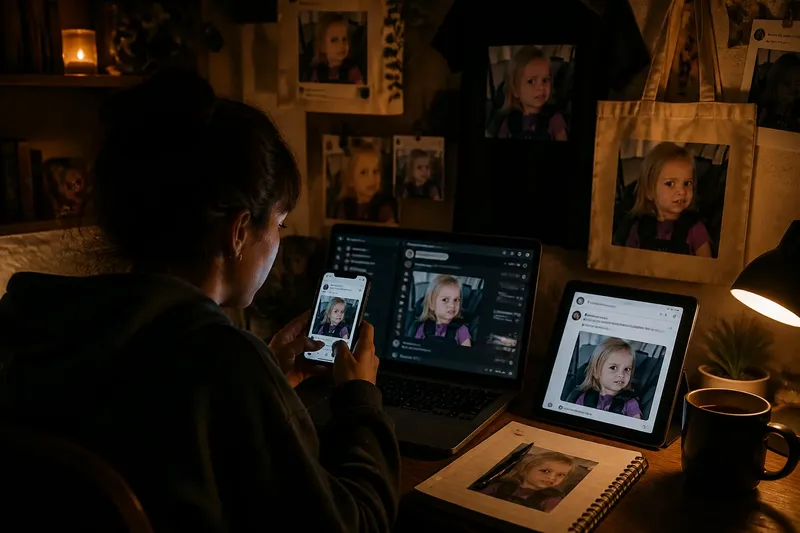
A repeated image becomes a cultural reference when people recognise it quickly and understand what its reuse implies. A reaction image in a group chat, a cropped scene in a fan forum or a familiar pose on a poster can carry a message beyond what the image originally showed. Repetition makes the image easier to recall; shared context gives that recognition a meaning people can use.
What makes repetition matter?
Seeing an image more than once can make its visual details familiar: a face, gesture, colour arrangement or unusually framed moment. Familiarity alone does not make it a cultural reference. The image needs to become useful in communication, so people choose it to express something that would otherwise take more words or explanation.
That usefulness may come from a contrast between the image and a new situation. A character looking unimpressed, for instance, can stand in for a reader’s response to an irritating announcement. The image’s original setting remains visible, but the new use shifts attention towards the emotion or situation it now represents.
Each repetition can make the connection easier to recognise. It can also alter it: a caption, crop, translation or new platform may emphasise a different detail. The result is not simply an image copied many times. It is an image whose recurring use teaches people how to read it.
Look for the meaning that stays recognisable across different uses, not just the number of times the image appears.
When does recognition become shared?
Recognition becomes shared when people can anticipate how others will interpret the image. One person may post it to suggest disbelief; another understands the suggestion without asking what the source image depicts. That common expectation lets the image work as a compact social cue.
Shared recognition does not require everyone to know the image’s origin. Some users may recognise a character or scene, while others only know the familiar format and its usual tone. A reference can therefore have layers: one reading for people who know the source and another for people who have learnt the image through later uses.
These layers matter in mixed audiences. In a private chat, friends may rely on a running joke that outsiders cannot follow. In a public post, the same image may be legible through a broader convention, such as using a dramatic reaction to signal overstatement. The intended audience affects how much context the image can carry.
When choosing an image, consider what the people receiving it are likely to recognise—and what they might miss.
How does context change its meaning?
Context tells viewers what part of an image to notice and how to connect it to the present moment. A face that looks anxious in its original scene might be reused to convey anticipation, dread or comic exaggeration. The image has not changed, but the caption, conversation and audience guide its interpretation.
Platform conventions shape that reading too. A reaction image in a messaging app responds directly to a previous message. The same picture printed on a tote bag has no immediate conversational turn; it may signal taste, affiliation or an interest in the joke. Placement and timing are part of the reference, not packaging around it.
Context can also limit an image’s usefulness. If the reference depends on a specific story, community or recent conversation, people outside that circle may read it differently or not recognise it. That does not mean the image has failed. It may be doing its work precisely within a smaller group.
Before reusing an image, ask what the surrounding words and setting will make visible.
Why do people reuse images?
Reuse gives people a quick way to show a stance, mood or relationship to a conversation. An image can add humour, soften criticism or make frustration feel shared. It can also let someone participate in a group’s language without composing a fresh explanation each time.
Consider an invented situation: a student receives a timetable change that adds an awkward gap between classes. They post a familiar image of a character staring at a clock, with a short caption about the wait. Friends who recognise the format may read it as mock exasperation, while the caption explains enough for classmates unfamiliar with the image. The observable result is a response that combines a specific complaint with a readily understood tone.
People also reuse images because repetition creates continuity. Seeing a familiar format recur can make a conversation feel connected to earlier jokes or shared experiences. But the same familiarity can make a reference feel stale if it no longer adds a useful twist or fits the current mood.
Use a reference when it clarifies your tone or relationship to the subject, not merely because the image is familiar.
Can an image mean different things?
Yes. A recurring image can communicate different things across communities, moments and audiences. One group may treat it as affectionate teasing; another may see it as dismissive. Even within the same group, a change in caption or target can turn a playful reference into a pointed one.
The image’s source is only one part of its meaning. Repetition builds later associations, and those associations may become more prominent than the original scene. A familiar still might be recognised mainly as a reaction format by people who have never watched the film or programme it came from.
When a reference lands badly, explain the intended point plainly rather than assuming everyone shares the same reading. A useful reply can acknowledge that the image carries different associations for different people, then clarify what you meant in that particular conversation.
Check the audience and target before treating a reference as universally understood.
What changes when an image spreads?
As an image circulates, people may crop it, add text, redraw it, translate a caption or place it in a new format. Each alteration can make the reference easier to use in another setting, while also changing which details remain visible. A tight crop may preserve a facial expression but remove the scene that gave it its original tone.
Spread can therefore separate a reference from its source. Some users may value that independence: the image becomes a flexible shorthand rather than a reminder of one particular work. Others may care about attribution or the source context, especially when the image depicts a real person or carries a meaning that a casual edit obscures.
There is no single point at which an image becomes a cultural reference. The shift is visible when people can use it in new situations and expect others to recognise not only its appearance but its communicative purpose.
Notice which parts survive each adaptation; those details often hold the reference together.
How can you read a reference?
Start with what the image shows, then ask what its reuse is doing in this particular setting. A few practical questions can separate recognition from interpretation:
- What is visible? Note the expression, gesture, framing, caption and any obvious source cues.
- Where does it appear? A reply, profile picture, poster or printed object gives the image a different role.
- What does it answer? Connect it to the message, event or mood immediately around it.
- Who is expected to recognise it? Consider whether the meaning relies on a shared joke, source or platform convention.
- What has changed? Compare the current crop or caption with details that might have been removed or reframed.
- What is the likely tone? Decide whether the reuse signals humour, affection, frustration, criticism or something less clear.
These questions do not produce one official interpretation. They help you describe how the image is working, and where your reading depends on knowledge another viewer may not share.
Why do some references last?
References endure when an image remains easy to recognise and useful across changing conversations. A distinctive expression or composition can make it memorable; a flexible meaning can let people apply it to more than one situation. But flexibility alone is not enough if the image is difficult to identify or no longer fits the way people communicate.
Some references persist inside a particular community rather than becoming broadly familiar. Others circulate widely but soon lose their force. Their reach and their staying power are different questions: an image can be briefly visible everywhere without becoming a lasting part of shared expression.
To understand why a repeated image becomes a cultural reference, follow the link between its recognisable form, the uses people give it and the context that lets others catch the point. The most revealing clue is often not the original image, but what people keep asking it to say.